Community Commitments

Fostering strong community relationships, and creating shared value


The Graphite Creek property is in close proximity to the Iñupiaq communities of Teller, Mary’s Igloo and Brevig Mission and roughly 37 miles from the City of Nome.

We are committed to cultivating long-term relationships with key stakeholders built on mutual respect, trust, and the advancement of shared interests — such as environmental stewardship, stable village economies, and maximizing local employment.
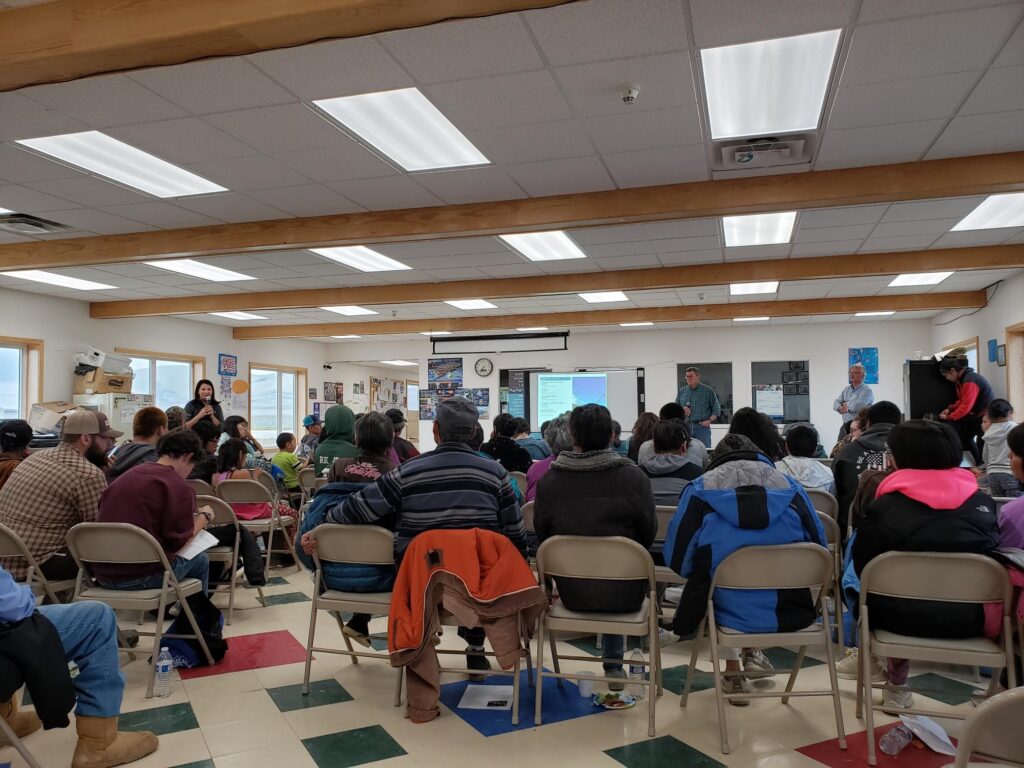
Our team consistently meets with tribal, city and corporate leaders of the local communities of Teller, Mary’s Igloo and Brevig Mission, and has consulted with key leadership, the general public and various community groups in the City of Nome.

Regular meetings have also been held with regional organizations and governing bodies such as Kawerak, Inc., Bering Straits Native Corporation, Nome Chamber of Commerce, Sitnasuak Native Corporation, Nome Eskimo Community, and the NACTEC – VOCED training center in Nome.

We strive to provide timely and pertinent information on project status and long-term aspirations and expectations, and seek feedback and input from community leaders. Our open-door policy encourages the communities to initiate communication whenever they feel they need an update or have questions or concerns.

During our ongoing public and local leadership meetings, we continue to address the following key concerns shared by stakeholders:

  • Subsistence resources and traditional way of life
  • Environmental protection
  • Access options
  • Local hiring opportunities
  • Training opportunities
  • Economic development
  • Protecting the culture and identity of rural communities

We understand and value that subsistence is deeply engrained in Iñupiaq culture and society.

In order to provide an additional forum for meaningful two-way communications on subsistence issues, we have assisted the Iñupiaq communities in the creation of a Subsistence Advisory Council (SAC) consisting of community members nominated by the city, tribal government and village corporations.

The purpose of the Council, which features representation from 8 different community groups within Brevig Mission, Teller, Mary’s Igloo, and Nome is to provide guidance and advise our project team through recommendations on the following issues:

  • Helicopter activities and routes during hunting season
  • Wildlife interaction
  • The company’s subsistence resource database

SAC members participate in an annual meeting, conduct site-visits as needed, and serve as liaison between the project team and the community members when appropriate.

Our team looks forward to deepening the dialogue with SAC members as work at the project site moves forward, and will continue to consider the input received on local subsistence resources and practices into future plans.

Much of our ongoing dialogue with local communities is dedicated to environmental stewardship and subsistence resource issues.

To ensure that our Project meets or exceeds all regulatory standards — with regards to impacts on the environment, including the fish, plants and game, and air, land and water upon which surrounding Iñupiaq communities depend — environmental baseline studies have been ongoing since 2014.

In our effort to support local communities and support local educational and professional training initiatives, Graphite One has provided multi-year to donations to the Communities of Brevig Mission and Teller, Nome’s NEST facility, and various other local school and non-profit organizations.  Through our investment partnership with BSNC, we have established scholarship funds to benefit local residents.

Graphite One is the first critical mineral project to have
direct investment from three Alaska Native Regional Corporations
Community
FAQs

We believe the Graphite Creek project is a generational economic development opportunity for the region that will provide stable, long-term jobs and be a driver for additional economic activity in the region. Graphite One has prioritized local hire whenever possible during our years of exploration and pre-development work. During operation, we expect to offer nearly 250 full-time positions with a goal of 100% local hire. We feel strongly that our employees should be part of the surrounding communities and we are developing plans for the company to partner on housing with long-term employees.

Since 2014, Graphite One has hosted approximately 75 meetings with local residents, Tribal organizations, Native corporations, local governments and through our Subsistence Advisory Committee. Participants in those meetings have consistently provided feedback that Graphite One has incorporated into our project plan.

Everyone at Graphite One understands the importance of subsistence resources and the traditional activities that have taken place around the project site for many generations. As mentioned above, Graphite One has taken the local feedback we have received to heart and repeatedly changed our project as a result. For instance, we have moved project infrastructure out of the Cobblestone Creek drainage to address concerns about potential impacts to the watershed. Additionally, we chose a route for the access road to the project that avoids areas popular for subsistence harvest and have agreed to restrict outside use of the access road at the request of local residents.

Separating graphite from waste rock does not require the intense chemical processes commonly used at hard rock metal mines. Rather, Graphite One will utilize diesel fuel, methyl isobutyl carbinol (alcohol) and other materials commonly found on work sites and in homes across Alaska to float the graphite and separate it from the waste rock.